EU membership can be a strategic advantage for company operations
For an entrepreneur thinking long-term and aiming to build a stable business in the European market, Poland is currently one of the best places to start. One of the main reasons is Poland’s membership in the European Union – not just formal, but active and economically well-leveraged. Thanks to EU integration, Poland offers access to the common market, financial instruments, and a unified legal system that ensures predictability and security for doing business.
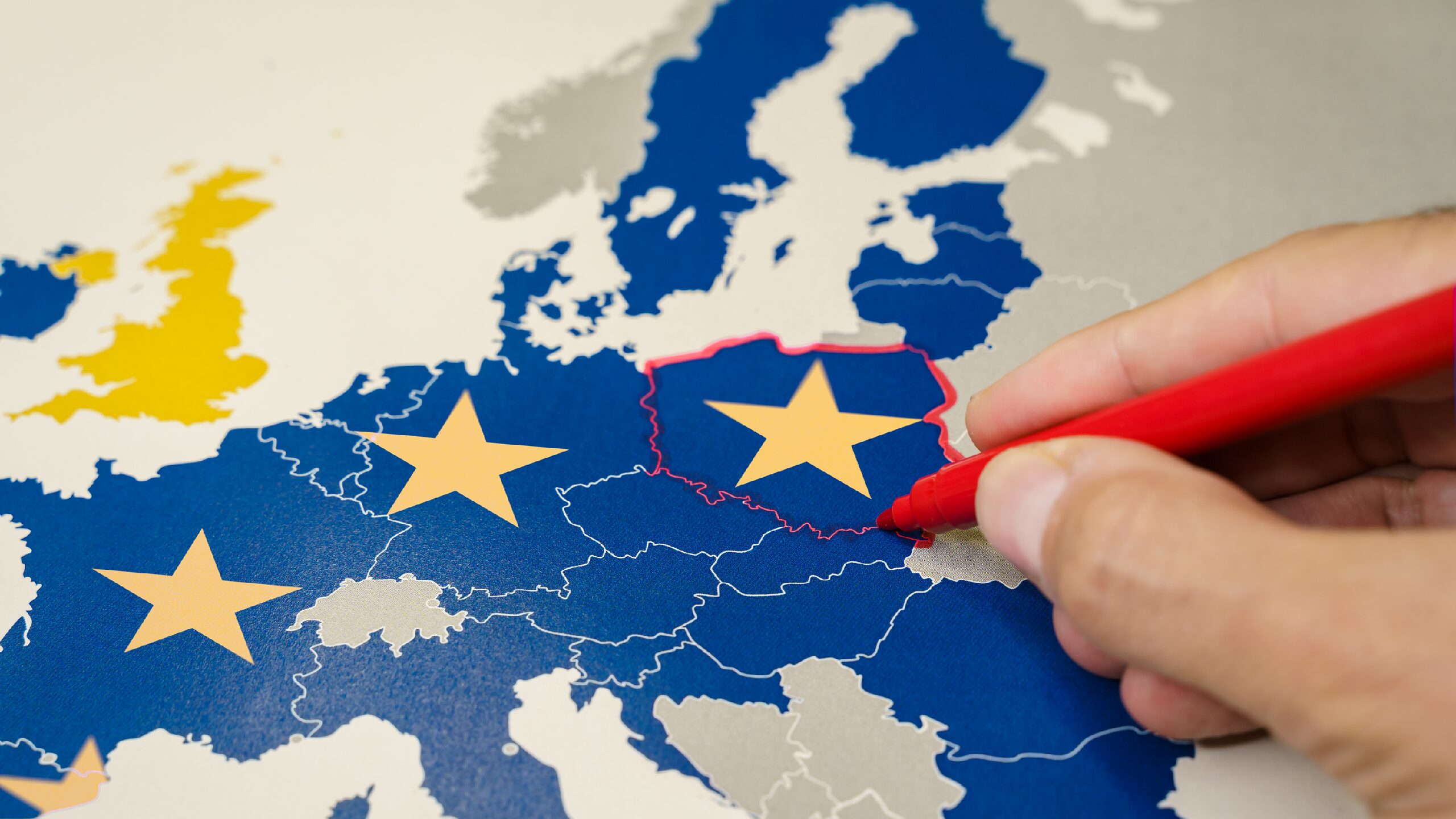
The EU single market – free movement of goods and services
Poland is part of the EU single market, meaning there are no customs or administrative barriers to intra-EU trade. In practice, a company registered in Poland can:
• sell goods and provide services to other EU countries without additional permits,
• issue EU VAT invoices and benefit from simplified tax rules,
• carry out cross-border transactions – both B2B and B2C – without the need to register a local entity in each country.
This makes Poland an excellent launchpad for companies looking to enter the German, French, Scandinavian, or Spanish markets without establishing separate entities in each of those countries.
Access to EU funds, grants and support instruments

Poland has long been one of the largest beneficiaries of EU funding, which directly translates into tangible support for companies registered here.
Businesses can apply for:
• investment grants for product development, infrastructure or international expansion,
• innovation funding (R&D), digital transformation and green initiatives,
• preferential loans and EU-backed guarantees (e.g. EIB, PARP),
• financing for training and export projects.
Importantly, many of these programs are also open to companies with foreign capital, as long as they operate in Poland.
Stable and EU-compliant legal environment
Running a company in Poland means operating within the EU legal framework, which ensures predictability, transparency and alignment with regulations across the Union.
This means:
• common standards for consumer protection, data privacy (GDPR), and fair competition,
• transparent rules for public procurement, taxes and reporting,
• easier dispute resolution through mutual recognition of judgments and harmonized rules (e.g. European payment order),
• streamlined conditions for digital trade and cross-border online services.
From a foreign entrepreneur’s perspective, this eliminates the risk of unfamiliar or “exotic” laws – the legal framework in Poland is based on the same EU principles as in Germany, France or Spain.
Free movement of capital and workers
EU membership also guarantees free movement of capital.
Investors can:
• inject funds into Polish companies from anywhere in the EU,
• withdraw profits, dividends or shareholder loans freely,
• open bank accounts in euros or other currencies in Polish banks,
• hire EU nationals without needing work permits.
For foreign investments (e.g. from the US, UK or Canada), Poland offers clear procedures and no capital controls – which is not always the case elsewhere.
Credibility and reputation
A company based in an EU member state inspires trust among contractors, banks, investors and customers.
This is especially relevant for:
• participating in public tenders (including international ones),
• signing contracts with partners from other EU countries,
• securing funding from EU institutions (e.g. European Investment Bank),
• positioning the company as transparent and compliant with European standards.
For many entrepreneurs – especially those outside the EU – setting up a company in Poland is the simplest way to legally and effectively operate across the Union.
FAQ – frequently asked questions
Can a non-EU citizen establish a company in Poland?
Yes. Poland does not restrict the right to establish limited liability companies (sp. z o.o.) for non-EU nationals. The process can be completed remotely, and the company may be 100% foreign-owned.
Can a company registered in Poland operate throughout the EU?
Yes. As an EU member state, Poland offers access to the single market. A company registered in Poland can provide services and sell goods across the EU without setting up local entities in other countries.
What types of EU funding are available to companies in Poland?
Businesses can apply for a wide range of support – from R&D grants, digitalisation and export subsidies, to preferential loans. Programs are available at both national and regional levels.
Can companies with foreign capital benefit from EU funds in Poland?
Yes – as long as they conduct actual business operations in Poland. Foreign capital does not exclude eligibility.
How long does it take to set up a company in Poland?
Online registration (via the S24 system) takes 1–2 business days. Traditional registration (with a notarial deed) takes about 1–2 weeks. The entire process can be handled remotely via a legal representative.
Can I run an online store in Poland for customers across Europe?
Yes. A company registered in Poland can run an e-commerce store targeting all EU countries, issue EU VAT invoices and use the One Stop Shop (OSS) for simplified VAT settlements.